Omnichannel E-Commerce Platform
A unified multi-channel e-commerce hub connecting Amazon, Flipkart, Shopify, Myntra, Meesho, and WooCommerce into one dashboard for inventory sync, order management, and logistics.
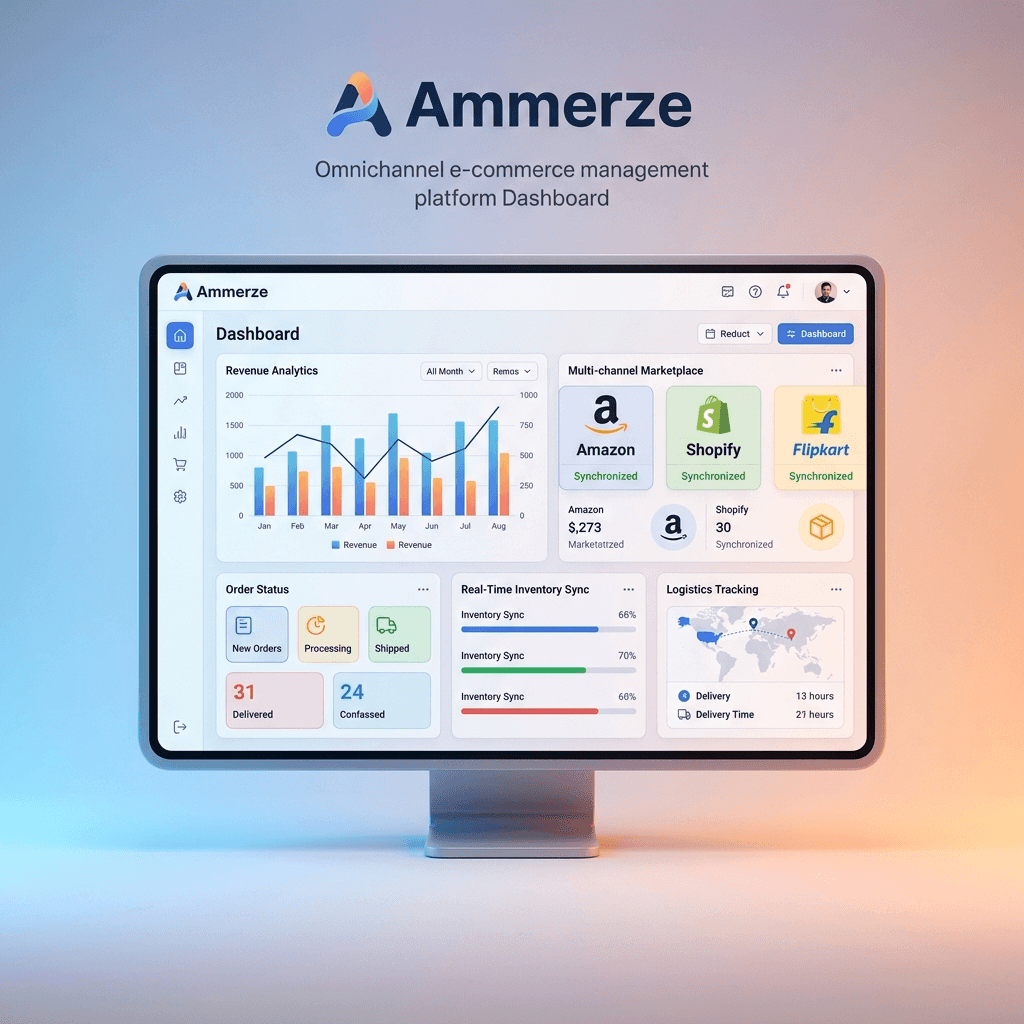
Any D2C or enterprise seller running on more than one marketplace hits the same wall eventually: inventory, orders, and fulfillment end up scattered across five different dashboards, and keeping them in sync by hand is a losing game. This platform was built to solve exactly that, and it now runs as the operational backbone for D2C brands, multi-warehouse retailers, and quick-commerce sellers managing storefronts across Amazon, Flipkart, Shopify, and Myntra.
The Challenge
Selling across multiple marketplaces means running the same product catalog through several disconnected systems that don't talk to each other. Without a single source of truth, sellers were routinely overselling stock that was already gone in one channel, missing orders buried in a different marketplace's dashboard, and losing hours a week reconciling what was actually in the warehouse against what five different portals claimed. Batch dispatch — packing, labeling, and handing off orders to a courier — was a manual, tab-switching slog that could eat the better part of a working day. None of the off-the-shelf tools handled this at real transaction volume without becoming a second full-time job to operate.
Why This Team
Building an omnichannel platform isn't a CRUD-app problem — it's a real-time data consistency problem wearing an e-commerce dashboard's clothes. Multiple marketplaces writing to and reading from the same inventory count at once means the sync layer has to be engineered for correctness under concurrent updates, not just for a nice-looking UI on top. We were chosen because we treat that sync and consistency layer as the actual product and design the storage and API layer around it before anything else gets built — which is why PostgreSQL was chosen over a looser document store for this specific workload, and why the integration layer was architected to onboard new channels and carriers without a rewrite.
Our Approach
We built outward from the two hardest problems first: a centralized order management system that consolidates every channel's orders into one queue, and a real-time inventory sync engine that locks and updates stock levels across every connected marketplace the moment a sale happens anywhere. Getting that foundation right — with dynamic threshold buffers to protect against sync lag — meant the rest of the platform could be layered on top without inheriting data-consistency bugs downstream.
From there we built a courier-selection algorithm into the fulfillment pipeline so every order automatically routes to the most cost-effective carrier, wired in accounting reconciliation so GST-compliant invoices flow straight into the firm's books, and shipped this as an ongoing engagement — iterating in production as the platform scaled from a handful of pilot sellers toward its current tiered, multi-tenant subscription model spanning single-channel starters up to enterprise accounts with dedicated support.
The Solution We Built
The platform runs on Next.js and Node.js with PostgreSQL as the data layer, chosen specifically for the real-time sync guarantees a live omnichannel inventory system needs. Core capabilities include:
- Unified Omni-Channel Dashboard — one view across every connected marketplace instead of switching between half a dozen seller portals
- Real-Time Inventory Synchronization — stock levels update across every connected channel the moment a sale occurs anywhere, with dynamic threshold buffers protecting against sync lag
- Centralized Order Management (OMS) — every channel's orders land in one queue, with 1-click batch label generation, GST tax invoices, and dispatch manifests
- Integrated Shipping & Logistics Routing — automated courier assignment and AWB generation through logistics integrations, with an algorithm that selects the optimal carrier per order rather than defaulting to one
- Accounting Reconciliation — GST-compliant invoices auto-generated and pushed into accounting systems, closing the loop between sales and books without manual re-entry
- Sales & Channel Performance Analytics — surfaces sales velocity and channel-level performance so sellers can see which marketplace is actually driving margin, not just volume
The overselling and stockout problem isn't a UI problem — it's what happens when five systems each think they own the truth. Fix the sync layer and the rest of the operational chaos mostly disappears with it.
The Outcome
In production, the platform now holds inventory sync accuracy above 99.9% with zero-error overselling protection backed by an SLA guarantee — a direct result of treating the sync engine as the core product rather than a background job. Batch dispatch that used to take the better part of half a day now completes in well under an hour, a multiple-times improvement that sellers report as 20+ hours of warehouse time saved every week. What started as a handful of live integrations has grown into a platform connecting a double-digit number of channels and carriers, with a clear runway toward far more as the roadmap expands.
For any D2C brand or enterprise seller drowning in multi-channel operational complexity, this is a working demonstration of what's possible when the inventory and order layer is built correctly from day one instead of patched together after the fact.
On This Page
Quick Actions
Built With
Key Features
- Unified Omni-Channel Dashboard
- Real-Time Inventory Synchronization
- Centralized Order Management (OMS)
- Integrated Shipping & Logistics Routing
- Sales & Channel Performance Analytics
More of our top projects

CreditKlick Financial Website

CreditKlick Mobile Experience